Thursday, May 29, 2008

My questions to Obama -Fidel Castro

It would be dishonest of me to remain silent after hearing Barack Obama's speech delivered at the Cuban American National Foundation last Friday. I feel no resentment towards him, for he is not responsible for the crimes perpetrated against Cuba and humanity. Were I to defend him, I would do his adversaries a favour. I have therefore no reservations about criticising him and expressing myself frankly.

What were Obama's statements? "Throughout my entire life, there has been injustice and repression in Cuba. Never, in my lifetime, have the people of Cuba known freedom. Never, in the lives of two generations of Cubans, have the people of Cuba known democracy ... I won't stand for this injustice ... I will maintain the embargo."

This man who is doubtless, from the social and human points of view, the most progressive candidate for the US presidency, portrays the Cuban revolution as anti-democratic and lacking in respect for freedom and human rights. It is the same argument US administrations have used again and again to justify crimes against our country. The blockade is an act of genocide. I don't want to see US children inculcated with those shameful values.

No small and blockaded country like ours would have been able to hold its ground for so long on the basis of ambition, vanity, deceit or the abuse of power, the kind of power its neighbour has. To state otherwise is an insult to the intelligence of our heroic people.

I am not questioning Obama's great intelligence, his debating skills or his work ethic. He is a talented orator and is ahead of his rivals in the electoral race. Nevertheless, I am obliged to raise a number of delicate questions. I do not expect answers; I wish only to raise them for the record.

Is it right for the president of the US to order the assassination of any one person in the world, whatever the pretext? Is it ethical for the president of the US to order the torture of other human beings? Should state terrorism be used by a country as powerful as the US as an instrument to bring peace to the planet?

Is an Adjustment Act, applied as punishment to only one country, Cuba, in order to destabilise it, good and honourable when it costs innocent children and mothers their lives? Are the brain drain and the continuous theft of the best scientific and intellectual minds in poor countries moral and justifiable?

Is it fair to stage pre-emptive attacks? Is it honourable and sane to invest millions and millions of dollars in the military-industrial complex, to produce weapons that can destroy life on earth several times over? Is that the way in which the US expresses its respect for freedom, democracy and human rights?

Before judging our country, Obama should know that Cuba - with its education, health, sports, culture and science programmes, implemented not only in its own territory but also in other poor countries around the world, and in spite of the economic and financial blockade and the aggression of his powerful country - is proof that much can be done with very little. Cuba has never subordinated cooperation with other countries to ideological requirements. We offered the US our help when hurricane Katrina lashed the city of New Orleans. Our revolution can mobilise tens of thousands of doctors and health technicians. It can mobilise an equally vast number of teachers and citizens who are willing to travel to any corner of the world to fulfil any noble purpose, not to usurp rights or take possession of raw materials.

The goodwill and determination of people constitute limitless resources that would not fit in the vault of a bank. They cannot spring from the hypocritical politics of an empire.

Tuesday, May 27, 2008

IMF and World Bank - Rascist organizations

The International Monetary Fund and the World Trade Organization promised that more trade would help to eradicate poverty and hunger. Food crops? Self-sufficiency in food? They had a better idea. Local farms would be closed down or encouraged to concentrate on exports. This would make the most, not of natural conditions which might be good for growing tomatoes in Mexico or pineapples in the Philippines, but of the fact that production costs are lower in Mexico and the Philippines than they are in Florida or California.

Farmers in Mali would rely on more highly mechanised, more productive producers in the Beauce or the Midwest for grain supplies. The farmers would pack up, move into town and get jobs in some western firm that had relocated to take advantage of cheaper labour than it could find at home. The countries on the East African seaboard would lighten their load of foreign debt by selling their fishing rights to the factory ships of wealthier countries. The Guineans would import tinned fish from Denmark or Portugal. Never mind the additional pollution generated by transporting all these goods. A life of bliss was guaranteed and so were the profits of the middlemen – wholesalers, shippers, insurers, advertisers.

The World Bank, prime promoter of this “development” model, now tells us that there may be food riots in 33 countries. And the WTO fears a resurgence of protectionism: some food-exporting countries – India, Vietnam, Egypt, Kazakhstan – have decided to reduce exports in order to feed their own people. What a nerve! The North is easily upset by other people’s selfishness. The Chinese eat too much meat, that’s why the Egyptians are short of wheat.

Some states have followed the World Bank and IMF advice and turned over their food crops. They can no longer keep their produce for themselves. Well, they will pay, that’s the law of the market. According to UN Food and Agriculture Organisation figures, their bill for grain imports has risen by a massive 56% in one year. Naturally the World Food Programme (WFP), which feeds 73 million people in 78 countries every year, is asking for a further $500m.

Someone must have decided this was excessive, as it got only half that amount. But the sum it sought was only what the war in Iraq costs every couple of hours, and a tiny fraction of what the sub-prime mortgage crisis will cost the banking sector, which has been bailed out by the state. To look at it another way, the WFP asked on behalf of millions of starving people for 13.5% of the sum earned last year by John Paulson, the astute hedge fund manager who realised that thousands of Americans are in negative equity and face ruin. No one knows how much the incipient famine will yield or who will reap the profits, but nothing is ever lost in a modern economy.

History repeats itself, one speculation after another. The Federal Reserve’s monetary policy encourages debt, first the internet bubble, now the real estate bubble. In 2006 the IMF was still saying there was “every indication the mechanisms for granting loans on the US property market were still relatively effective”. Market effective. Perhaps the two words should be welded together once and for all. The real estate bubble has burst. So the speculators are resurrecting an old eldorado: the grain markets. Purchasing contracts to deliver wheat or rice at a future date and counting on selling them at a higher price. And what ensures prices will keep on rising? Famine.

So what does the IMF do? The IMF, which has “the best economists in the world” according to its managing director, explains that “one way to solve the problem of famine is to increase international trade”. The poet Leo Ferré once said that “all you need to sell despair is the right formula”. It looks as though they’ve found it.

India's food crisis and neo-liberal conspiracy

FOOD CRISIS EXPOSES FAILINGS OF INDIA'S ECONOMIC REFORMS

The recent escalation in food prices is the latest calamity to hit the poor and marginalised communities in India. The price of food and other essentials has been rising for the last 12 weeks and the current inflation level is the highest witnessed since November 2004. Retail prices of some essential food commodities have seen a sharp increase. Retail prices of gram, sugar, mustard oil, vanaspati and onions have increased by up to 11 per cent in the national capital in last one month, pushing inflation to a 39-month high of seven per cent. (1)

"SHINING INDIA" AT THE COST OF "SUFFERING INDIA" Facing public outrage on rising food prices, the United Progressive Alliance (UPA) government, took refuge by issuing statements that inflation is a global phenomenon. Even though it is a global phenomenon and food riots have been witnessed in more than 30 countries, the food crisis in India is primarily caused by the pro-market biased policies of the government. Indians (along with the Chinese) have been accused of eating more due to rising prosperity resulting in the global food shortages. But the per capita food consumption and calorie intake indicates that irrespective of the current inflationary trend, majority in India are facing hunger and starvation since liberalisation policies were introduced.

The irony is that though signs of the food and agriculture crisis were evident, policy makers continued with neoliberal policies to benefit corporations. The government is witness to the increasing schism between 'shining India’ and ‘suffering India’ but their mantra has always been that only the pro-capitalist, corporation driven economy can bring sustained economic growth which will trickle down to benefit the disadvantaged sections of the population. Despite looming inflation, the Economic Advisory Council to the Prime Minister of India believes that robust investment growth and strong corporate performance would drive India towards prosperity. It also says that “in the current year, the strong growth in agricultural GDP has come mostly from activity other than food grain production, namely commercial crops, horticulture and animal husbandry.” (2)

This paradigm shift in foodgrain production was introduced under the World Bank direction which “required India to move away from the existing subsidy-based regime and instead, invest in building a solid foundation for a highly productive, globally competitive and diversified farm sector.” (3). The report recommended the removal of subsidies related to grain procurement and Public Distribution System (PDS), diversification of Indian agricultural development, increased space for the private sector in agriculture extension services, contract farming and for agro-industry in general. Interestingly during the recent crisis the Indian government severely criticised the World Bank for their advice to countries to shift from food crops for domestic population to cash crops for exports. (4) Addressing a special meeting of the United Nations Economic and Social Council to consider the issue of rising food prices, India’s UN Ambassador Nirupama Sen, said that the “tradition of these institutions’ advice was partly responsible for the crisis in the first place”.

The corporate led growth regime has contributed to mass displacement of mainly small and marginal farmers, leading to loss of livelihood opportunities and employment generation for the common people. The widespread farmers’ suicides, which reached 150,000 (5) in just eight years (1997-2005), is a manifestation of the ongoing corporatisation and mindless deregulation of the agricultural sector. Though India is seen as a rising economic power and it is hoped that a trickle down effect will benefit the poor and marginalized, in reality the gap between ‘Shining India’ and ‘Suffering India’ is widening: 77 percent (6) of the Indian population who survive on Rs. 20/- (half a US dollar) a day, does not figure in this ‘booming Indian economy’.

MYTH OF GLOBAL MARKET INTEGRATION Two years of wheat imports have exposed the fallacies of neoliberal policies. India, once a wheat exporting country was forced to become the largest wheat importer through a design to benefit the global food corporations. The declining procurement of locally produced wheat by the Food Corporation of India (FCI) prepared the ground for wheat imports. This was a sea change from the situation during 2001-2002 to 2004-2005, when the country exported 12.4 million tonnes of wheat. Since early 2006, the USA was pressuring India to break its tariff wall and open up for wheat imports. In March, despite predictions of a bumper wheat harvest, the US Wheat Associates (7) said India would import up to 30 lakh tonnes of wheat in that year. (lakh = 100,000). Following this, the government reduced the applied tariff on wheat from 60 per cent to zero for imports by the State Trading Corporation of India (STC) while for private traders, the duty was brought down to five per cent. This led to import of 5.5 million tonne of wheat in 2006 at prices ranging in between US $178.75 to US $228.94 (8) a tonne when the local wheat production was 69 million tonnes. In 2007 the government first scrapped a wheat import tender at an average price of $263 per tonne in June citing high prices but in July, less than 40 days later, it contracted 5.11 lakh tonne of wheat at an average price of $325.59 per tonne. Then again on September 3, it contracted 7.95 lakh tonne of wheat at an average price of $389.45 (9) but only 1.8 million tonnes of wheat finally landed on Indian ports at double the price of last year despite increase in wheat production upto 74.82 million tonnes in that year. Thus the government paid foreign traders exorbitant price upto Rs 16,000 per tonne while the MSP (market spot price) was only Rs. 8500 per tonne. And the main beneficiaries of the India’s wheat import were giant grain corporation like Glencore, Toepfer, Cargill and the Australian Wheat Board who gained at the cost of Indian farmers. However, the import of wheat at expensive rates led to the sharp increase in local wheat and wheat flour prices making it unaffordable for the poor.

The story of wheat is not different from what happened in late 1990s in the edible oil sector when under pressure from the USA, India reduced the duty on the crude edible oil to 15 per cent in August 1998. In July 1999 Oil World reported that India was set to replace China as the world's largest vegetable oil importer and projected India’s import around 3.6 million tonnes (MT) in 1998-99 oil year. In the first nine months India had imported 3 MT oil and during 1998-99 oil year, edible oil import amounted to a massive 4.4 MT, an increase of 111 per cent over the previous year's 2.08 MT. The increasing reliance on imports considerably weakened the domestic edible oil production.

In spite of the above experiences, early this year the government allowed liberalisation of imports to deal with rising inflation by reducing import duty to zero in respect of articles like pulses, edible oil and maize; withdrawal of four per cent additional duty on edible commodities; reducing import duty on refined oil and vegetable oil by 7.5 per cent; reduction of import duty on butter and ghee to 30 per cent. But does the reduction in import duties and import of food grain help in containing the domestic food prices? In June 2006 the same government had unilaterally liberalised imports to bolster the supply side of essential commodities but this couldn’t control inflation. The government’s Economic Survey 2006-07 had said that “duty free wheat imports did not help to check price rise, rather the rising global prices impacted the domestic market in a subtle way”. A billion plus population of India cannot depend on the ‘ship-to-mouth’ existence and the government needs to restore its policy to build up food grain reserves in order to serve the farmers and the consumers. Moreover there is greater threat that the unilateral trade liberalisation as a solution to inflation would soften India’s position in WTO.

PUBLIC DISTRIBUTION UNDERMINED BY CORPORATIONS The Public Distribution System (PDS) (10) has been one of the most crucial elements of food policy and food security system in the country. But the Indian government has been deliberately weakening the public distribution system under the World Bank pressure to benefit the agribusiness corporations. India witnessed a shortage of wheat in 2005-2007 because systematically the foodgrain (wheat and rice) buffer stocks were lowered through below target offtake of grains by government from the farmers.

In order to make a case for wheat import under US pressure, the government went slow on the procurement of wheat in 2005-2007 and deliberately kept the government's purchasing price low to allow multinational corporations to enter the trade. In 2006, Cargill India, the Australian Wheat Board, and two Indian based companies with a lot of foreign equity, ITC and Adani Export, procured 30 lakh tonnes of wheat. In 2003-04, government procured 16.8 million tones of wheat which went down to 14.8 million tonnes in 2004-05 and it further reduced to 11.1 million tonnes in 2005-2006 and last year it was just 9.2 million tonnes. (11) The government deliberately created a situation of food insecurity in the country by allowing multinational corporations to move into agro-business and large procurement. However in 2008 it corrected its faulty policy of reduced procurement and procured a record 20.5 million tonnes (12) till 20 May this year, which is a huge jump from a meagre 11.1 million tonnes in the entire season last year, helped by a bumper crop and higher prices. Moreover the government went a step further and Indian Railways decided to stop allocating wagons for transporting wheat from the growing areas by the private trader, impacting their wheat procurement.

The reduced procurement of food grains resulted in reduced amount of off take by the state governments for the subsidized grain distribution through a network of more than 450,000 Fair Price Shops (FPS). An analysis of data from 2005-06 onward reflects a consistent fall in allocation of wheat in the BPL (below the poverty line) category, even while there was a perceptible upward shift in demand. (13) It means that at a time when open market prices of wheat were rising, there wasn’t enough wheat in the PDS for those eligible to buy it there for less than the market prices.

COMMODITY FUTURE: TRADING ON HUNGER Besides the agribusiness, the traders engaged in future trading in commodities were beneficiaries of the declining food procurement and shrinking of buffer stocks. Infact the opposition parties in India claimed that the lowering of procurement and shrinking of buffer stocks was meant to facilitate the speculative trading of foodgrains. Reduction in government stocks is imperative for the private traders and speculators to speculate on prices of foodgrains. Mr. Sitaram Yechury representing the Community Party of India (Marxist), debating the issue of price rise in the Parliament said that, “three billion dollars a day is the speculation that is taking place in the commodity exchange market of futures and forward trading” across three national level electronic exchanges and twenty-one regional exchanges. In just two weeks, from 17 March to 31 March 2008, the total value of trading at these commodity exchanges was Rs. 2,12,465.17 crores (14). The cumulative value of trade in the last financial year, from 1 April 2007 to 31 March 2008 was to the tune of Rs. 40,65,989 crores as compared to Rs. 5,71,759 two years ago in 2004-2005. One firm calculates that the amount of speculative money in commodities futures markets, where investors do not buy or sell a physical commodity, like rice or wheat, but merely bet on price movements – has ballooned from US$5 billion in 2000 to US$175 billion to 2007 (15). The price behaviour of food over 2007 and the first three months of 2008 is more or less explained by such speculation on food products.

But the speculation and bidding in food stocks does not benefit small and marginal farmers. The Economic Survey 2007-08 clearly stated that, "Direct participation of farmers in the commodity futures market is somewhat difficult at this stage as the large lot size, daily margining and high membership fees … work as a deterrent to farmers' participation in these Markets. Farmers can directly benefit from the futures market if institutions are allowed to act as aggregators on behalf of the farmers”. Though the government has put a ban on future trading of some crops, it may be opened up anytime, therefore the government must totally ban the futures trading of food commodities as demanded by the citizens groups and left parties.

RETREATING FROM CAPITALIST ECONOMY The UPA government under the leadership of Manmohan Singh seems to concede the failure of the capitalist system (but it could be a gimmick for the election, which is due in early 2009). The inflation also made him realise the viability of the small farm essential for the survival of millions of small and marginal farmers and to deal with the food crisis. Recently the Prime Minister made a statement which is discordant with the general pro-market reforms push, including promotion of contract farming, that the UPA government has encouraged for the past four years. At the Global Agro-Industries Forum, the Prime Minister said that, "collectivization, corporatization and land consolidation through land alienation are neither possible nor socially desirable, while warning that rising food prices could hamper the country's economic growth…We cannot wish away the existence of economically unviable farms… It is particularly worrisome that the new economics of biofuels is encouraging a shift of land away from food crops”. (16) Even two of his colleagues from the cabinet showed their concern on the capitalist economic model when Mr. Kamal Nath (Union Commerce Minister) and Mr. Sharad Pawar (Union Agriculture Minister), stated that if the need arose they were ready to look at invoking the Nehru-era controls built within existing commodity regulation laws. The last few months have witnessed several steps where the UPA government have retreated from its capitalist move and brought in government regulation to check inflation. One can infer from this development that the UPA government headed by Manmohan Singh (a former World Bank governor) has lost the confidence in the neo-liberal trajectory in agricultural reforms.

SMALL-SCALE FARMERS HOLD THE KEY Given the deepening of agrarian crisis which is causing hunger and malnutrition in rural areas due to unprecedented decline in purchasing power in the rural areas, the first priority of the government should be to strengthen the agriculture sector by increasing public investment, facilitating public control over inputs and market, strictly regulating the corporate investment in agriculture as well as retreating from neoliberal reforms in agriculture.

Since India is a land of small and marginal farmers, and over 650 million of its over one billion population are directly or indirectly dependent on agriculture, there is urgent need to encourage and strengthen biodiversity based small scale agriculture which are crucial for the food security of the millions of Indians. Infact, it is the small biodiverse farm, which has higher productivity than large industrial farms. Large farmers and industrial farming has serious limitations on increasing agricultural productivity. In the face of a worsening worldwide food-price crisis, even the President of the International Fund for Agricultural Development (IFAD), Mr. Lennart Båge feel that small farmers are now essential to ensure food security, spur economic growth and help mitigate climate change. He said that smallholder farmers are a vital global asset, a key factor for increased food production, economic growth and development, and mitigating climate change. The 2 billion people in rural areas in the developing world can be tremendously more productive. They can be part of the supply response, feeding the world, and also very much a part of the climate change agenda, both in terms of adaptation and mitigation. (17)

In India, small farm based on internal inputs are the only hope to deal with the impending food crisis and can ensure food security and food sovereignty to millions of people living off the farm. A food secure and peaceful India is in the hands of her small farmers

Wednesday, April 30, 2008

Beyond Munich: The UN Security Council Helps Disarm a Prospective Further Victim of U.S. Aggression

magine that when Hitler was threatening to invade Poland, after having swallowed Czechoslovakia-with the help of the Western European powers' appeasement of Hitler at Munich in September 1938-the League of Nations imposed an arms embargo on Poland, making it more difficult for the imminent victim to defend itself, and at the same time suggested that Poland was the villainous party. That didn't happen back in 1939, but in a regression from that notorious era of appeasement something quite analogous is happening now.

Here is the United States, still fighting a brutal war of conquest in Iraq, which it is now doing with UN Security Council approval, with open plans and threats to attack Iran and engage in "regime change," gathering aircraft carriers off the coast of Iran, already engaging in subversive and probing attacks on the prospective target, and the UN Security Council, instead of warning and threatening the aggressor warns, threatens and imposes sanctions on the prospective victim!

The way it works is that the United States stirs up a big fuss, proclaiming a serious threat to its own national security, and expressing its deep concern over another state's flouting of Security Council resolutions or dragging its feet on some point of order such as weapons inspections-we know how devoted the United States and its Israeli client are to the rule of law!

In the Iraq case, this noise was echoed and amplified in the media, often splashed across headlines and drummed up in editorial commentary. In turn, elite opinion in the United States and Britain coalesced around the beliefs (a) that a WMD-related crisis really existed in Baghdad and (b) that it required the Security Council's special attention. Straight through March 19-20 2003, Iraq, the prospective target of a full-scale attack, decried the absurdity of this U.S.-U.K. noise, and filed regular communiqués with the Security Council and Secretary-General documenting the U.S.-U.K. aerial strikes on its territory,[1] including the "spikes of activity" period from September 2002 onward.[2] The vast majority of the world's states and peoples also rejected the war propaganda-including the largely voiceless U.S. public, where in the weeks before the war, two-thirds of non-elite opinion stood firmly behind multilateral approaches to defuse the crisis, foremost of which was permitting the UN weapons inspections to take their course.[3] But then, as now, pretty much the entire world recognized the U.S.-U.K. hijacking of the Security Council, and its strategic misdirection away from a defense of the actual target of the threats (Iraq) onto the execution of the policy of the states making those threats while playing the role of Iraq's potential victims (the U.S. and U.K.).

So the aggression planning proceeded then and does now with the cooperation of the UN and international community. In the Iraq case, the Security Council allowed itself to be bamboozled into restarting the weapons-inspection process, accepting this as the urgent matter, rather than the war-mobilization and threat of aggression by the United States and its British ally. Although the Security Council did not vote approval of the U.S.-British attack, it helped set it up by inflating the Iraq threat and failing to confront the real threat posed by the United States and Britain. Then, within two months after "shock and awe," the Security Council voted to give the aggressor the right to stay in Iraq and manage its affairs, thereby approving a gross violation of the UN Charter after the fact.

Now, four years later, the Security Council has outdone itself. Not only has it failed to condemn the U.S. and Israeli threat to attack Iran-the threat itself a violation of the UN Charter,[4] and one made ever-more real by the U.S. invasions of neighboring Afghanistan and Iraq during this decade alone, now followed by a huge U.S. naval buildup near Iran's coast to levels not seen since the U.S. launched its war on Iraq four years ago in what the New York Times just called a "calculated show of force."[5] But even worse, the Council has aided and abetted these potential aggressors by adopting three resolutions in the past eight months under Chapter VII of the UN Charter, each of which affirms that Iran's nuclear program is a threat to international peace and security, and reserves for the Council the right to take "further appropriate measures" should Iran fail to comply-that is, should Iran not cave-in to U.S. demands on exactly the terms demanded.[6]

Since July 31, the Council has demanded that Iran "suspend all enrichment-related and reprocessing activities, including research and development"[7]-despite the fact that Iran's right to engage in these activities is guaranteed under the Treaty on the Non-Proliferation of Nuclear Weapons.[8] Since December 23, it has identified the existence of Iran's nuclear program with so-called "proliferation sensitive nuclear activities"[9]-despite the fact that the International Atomic Energy Agency has never shown Iran's program to be engaged in any kind of activities other than peaceful ones. Indeed, in the December 23 resolution, the Council used the phrase "proliferation sensitive nuclear activities" no fewer than eight different times to describe Iran's nuclear program, the clear-and perfectly false-allegation being that for Iran to do research on and develop its indigenous nuclear fuel capabilities places Iran in violation of its NPT commitments.

But perhaps most egregious of all, the March 24 resolution prohibits Iran from selling "any arms or related material" to other states or individuals (par. 5), and calls upon all states "to exercise vigilance and restraint" in the sale or transfer of a whole list of weapons systems to Iran, "in order to prevent a destabilizing accumulation of arms…" (par. 6).[10] As the editorial voice of The Hindu immediately recognized, the first term is critical "not so much because the Islamic Republic is a major vendor of weapons even to Hamas or Hizbollah but because it gives the U.S. an excuse to intimidate or interdict all Iranian merchant shipping under the guise of 'enforcement'."[11] Likewise with the second term, which, if history is any guide, Washington will interpret as a strict prohibition on weapons sales to Iran, thus depriving the potential victim, faced with attack by one or more nuclear powers, of the right to obtain even non-nuclear means of self defense. This of course has been a standard U.S. tactic over many years, even against puny victims-Guatemala in 1954 and Nicaragua in the 1980s, among other cases. But now the United States has succeeded in getting the Security Council to help it impede the self-defense of yet another target of aggression. In this truly Kafkaesque case, the state targeted for attack (Iran) has been declared a threat to the peace by the Security Council, at the behest of a serial aggressor openly mobilizing its forces to attack the "threat."[12]

It should be recognized that the treatment of Iran's nuclear program, and the Security Council's cooperation in this treatment, is the ultimate application of a global double standard, enforced by an aggressive superpower now able to get away with both hypocrisy and murder. Only the United States and its allies may possess nuclear weapons. They alone may threaten to use nukes. They alone may improve their nukes and delivery systems. Only client states such as Israel may remain outside the NPT indefinitely and without penalty. The United States may ignore its NPT obligation to work toward nuclear disarmament. It may even renege on its promise never to use nukes against nuke-free states that joined the NPT. But no matter. By sheer fiat-power, no other state may acquire nukes without U.S. consent. Nor as the case of Iran shows may a state engage in its "inalienable right" to use nuclear energy for peaceful purposes unless and until the United States approves.

We are in the midst of a crisis within the post-war international system, as a serial aggressor is now able to mobilize the Security Council, tasked with the maintenance of international peace and security, to declare the state that it threatens with war a menace to the peace and to help the aggressor disarm its target. This carries us beyond Munich.

Who Is The Greatest Rogue Of All

Most people believe that their own country is virtuous and that only others misbehave enough to qualify as international outlaws. But the United States has elevated this popular sentiment to the level of national policy, by designating certain countries, of its own choosing, as "rogue states."

The dictionary defines "rogue" as "a fierce and dangerous animal, like an elephant, that separates itself from its herd." By this standard, the United States, not the piddling tyrannies named by the State Department, is the world's number one rogue.

Since it obliterated Hiroshima and Nagasaki in 1945-cities, not military targets-the United States has bombed eighteen countries, and invaded still others, with no declaration of war nor any possibility of retaliation, at least until September 11, 2001.

And in the case of Afghanistan, the United States launched a unilateral war of revenge against a brutal regime of its own creation, although none of the 19 hijackers were Afghan and none of the thousands of "detainees" held in the United States and abroad have been charged with any participation in the crime. Furthermore, the alleged "mastermind," still at large, might well have been turned over to the United States through negotiations-which President Bush rejected outright from the start. PS: in case you haven't noticed, we don't negotiatee-except on our terms.

Of course all this is defended on the ground that we are "so good" (as the President has said) and always act in the world's interest. Can we explain the universally opposed embargo against Cuba as a global service? Did we support the murderous regime of Suharto in Indonesia for 32 years out of altruism-or because U.S. mining, oil and timber interests loved the "favorable climate of investment" the dictator provided for them?

In other cases too U.S. actions reflect the power of corporate interests. For example, the United States refused to participate in Organization for Economic Cooperation and Development-sponsored talks in Paris in May 2001, on ways to crack down on off-shore and other tax and money laundering havens. For any other nation, this would now be highly embarrassing in the age of Enron, but such a thought would never even occur to U.S. policymakers.

Or consider President Bush's declaration in March 2001 that the Kyoto Protocol for controlling global warming was "dead," and his refusal to participate in negotiations in Marrakech (Morocco) to revise it-all because it might harm the U.S. economy. So if the world thinks controlling global warming is more important than short-term negative economic effects, Bush separates himself from the global consensus based on his reading of U.S. interests alone-and his stance coincides with that of the oil and automobile industries, not with the real interests of the American people.

Several U.S. unilateral positions have been geared to the demands of the military-industrial complex, and other parties advocating an aggressive foreign policy. Last December the United States withdrew from the 1972 Anti ballistic Missile Treaty, gutting this landmark arms control accord to the dismay of virtually every country in the world.

The United States has not ratified the Comprehensive (Nuclear) Test Ban Treaty signed by 164 nations, and under Bush opposes it. This country rejects the Land Mine Treaty, concluded in Ottawa in December 1997 and signed by 122 countries; the Pentagon finds land mines useful, outweighing the "collateral damage" they entail for thousands of civilians every year.

In February 2001 we refused to join 123 nations to ban the use and production of anti-personnel bombs and mines; flexible killing power for the Pentagon must be preserved, regardless of human cost. This country was also the only nation to oppose the UN Agreement to Curb the International Flow of Illicit Small Arms in July 2001.

The United States rejects an International Criminal Court because our personnel might become subject to its jurisdiction. In 1986, the International Court of Justice in The Hague ruled that the United States was in violation of international law by sponsoring and supporting a Contra army to attack Nicaragua. The United States simply refused to accept the Court's jurisdiction, although it hastens to do so when the Court decides in its favor.

The United Nations is treated the same way: when the United States can get the Security Council to do what it wants, like bomb Iraq in 1991, it goes that route; when it sees it can't get UN backing, as in its invasion of Panama in 1989, it simply disregards the UN or uses its veto. As Secretary of State Madeleine Albright stated in 1998, "the United States acts multilaterally when it can, unilaterally when it must."

In the case of Afghanistan in 2001, the Bush administration couldn't be bothered with the UN or any other international body to deal with what it declared to be a "crime against humanity": it simply bombed. As for the treatment of prisoners shipped to Guantanamo chained, blindfolded, and classified as "unlawful combatants," South African jurist Richard Goldstone points out that this is "not a term recognized by international law." If they are prisoners, they are entitled to POW treatment; if simply criminals, "under the US Constitution. they've got even better protection."

But for U.S. leaders, international law is for others, not ourselves. Whether an action involves waging war, with the devastation and death that "precision bombing" brings to a chosen country, or expanding environmental controls and reducing global warming, the United States is proclaiming, more loudly than ever, that it will "act unilaterally" whatever the cost to others-and sooner or later to its own people.


Aswin Kumar

Tuesday, March 25, 2008

Petroleum and US crisis

Why the Dollar Bubble is about to Burst?

Currently almost all oil buying and selling is in US-dollars through exchanges in Londonand New York. It is not accidental they are both US-owned.
The Wall Street crash in 1929 sparked off global depression and World War II. During that war the USsupplied provisions and munitions to all its allies, refusing currency and demanding gold payments in exchange.
By 1945, 80% of the world's gold was sitting in US vaults. The dollar became the one undisputed global reserve currency -- it was treated world-wide as `safer than gold'. The Bretton Woods agreement was established.

The UStook full advantage over the next decades and printed dollars like there was no tomorrow. The US exported many mountains of dollars, paying for ever-increasing amounts of commodities, tax cuts for the rich, many wars abroad, mercenaries, spies and politicians the world over. You see, this did not affect inflation at home! The USgot it all for free! Well, maybe for a forest or two.

Over subsequent decades the world's vaults bulged at the seams and more and more vaults were built, just for US dollars. Each year, the USspends many more dollars abroad that at home. Analysts pretty much
agree that outside the US, of the savings, or reserves, of all other countries, in gold and all currencies -- that a massive 66% of this total wealth is in US dollars!

In 1971 several countries simultaneously tried to sell a small portion of their dollars to the USfor gold. Krassimir Petrov, (Ph. D. in Economics at OhioUniversity) recently wrote, 'The US Government defaulted on its payment on August 15, 1971 . While popular spin told the story of `severing the link between the dollar and gold', in reality the denial to pay back in gold was an act of bankruptcy by the US Government.' The 1945 Breton Woods agreement was unilaterally smashed.

The dollar and USeconomy were on a precipice resembling Germanyin 1929. The USnow had to find a way for the rest of the world to believe and have faith in the paper dollar. The solution was in oil, in the petrodollar. The USviciously bullied first Saudi Arabiaand then OPEC to sell oil for dollars only -- it worked, the dollar was saved. Now countries had to keep dollars to buy much needed oil. And the UScould buy oil all over the world, free of charge. What a Houdini for the US! Oil replaced gold as the new foundation to stop the paper dollar sinking.

Since 1971, the USprinted even more mountains of dollars to spend abroad. The trade deficit grew and grew. The USsucked-in much of the world's products for next to nothing. More vaults were built.

Expert, Cóilínn Nunan, wrote in 2003, 'The dollar is the de facto world reserve currency: the UScurrency accounts for approximately two thirds of all official exchange reserves. More than four-fifths of all foreign exchange transactions and half of all world exports are denominated in dollars. In addition, all IMF loans are denominated in dollars.'
Dr Bulent Gukay of KeeleUniversityrecently wrote, 'This system of the US dollar acting as global reserve currency in oil trade keeps the demand for the dollar `artificially' high. This enables the USto carry out printing dollars at the price of next to nothing to fund increased military spending and consumer spending on imports. There is no theoretical limit to the amount of dollars that can be printed. As long as the UShas no serious challengers, and the other states have confidence in the US dollar, the system functions.'

Until recently, the US-dollar has been safe. However, since 1990 Western Europe has been busy growing, swallowing up central and Eastern Europe. French and German bosses were jealous of the USability to buy goods and people the world over for nothing. They wanted a slice of the free cake too. Further, they now had the power and established the euro in late 1999 against massive US-inspired opposition across Europe , especially from Britain- paid for in dollars of course. But the euro succeeded.

Only months after the euro-launch, Saddam's Iraqannounced it was switching from selling oil in dollars only, to euros only -- breaking the OPEC agreement.. Iran, Russia, Venezuela, Libya, all began talking openly of switching too -- were the floodgates about to be opened?

Then aero planes flew into the twin-towers in September 2001. Was this another Houdini chance to save the US (petro) dollar and the biggest financial/economic crash in history? War preparations began in the US But first war-fever had to be created -- and truth was the first casualty. Other oil producing countries watched-on. In 2000 Iraqbegan selling oil in euros. In 2002, Iraqchanged all their petro-dollars in their vaults into euros. A few months later, the USbegan their invasion of Iraq.

The whole world was watching: very few aware that the USwas engaging in the first oil currency, or petro-dollar war. After the invasion of Iraqin March 2003, remember, the USsecured oil areas first. Their first sales in August were, of course, in dollars, again. The only government building in Baghdadnot bombed was the Oil Ministry! It does not matter how many people are murdered -- for the US, the petro-dollar must be saved as the only way to buy and sell oil – otherwise the USeconomy will crash, and much more besides.

In early 2003, Hugo Chavez, President of Venezuelatalked openly of selling half of its oil in euros (the other half is bought by the US). On 12 April 2003, the US-supported business leaders and some generals in Venezuelakidnapped Chavez and attempted a coup. The masses rose against this and the Army followed suit. The coup failed. This was bad for the US.

In November 2000 the euro/dollar was at $0.82 dollars, its lowest ever, and still diving, but when Iraqstarted selling oil in euros, the euro dive was halted. In April 2002 senior OPEC reps talked about trading in euros and the euro shot up. In June 2003 the USoccupiers of Iraqswitched trading back to dollars and the euro fell against the dollar again. In August 2003 Iranstarts to sell oil in euros to some European countries and the euro rises sharply. In the winter of 2003-4 Russian and OPEC politicians talked seriously of switching oil/gas sales to the euro and the euro rose. In February 2004 OPEC met and made no decision to turn to the euro -- and yes, the euro fell against the dollar. In June 2004 Iranannounced it would build an oil bourse to rival Londonand New York, and again, the euro rose. The euro stands at $1.27 and has been climbing of late.

IRAN HAS REALLY DONE IT…more deadlier than the nuclear..

The Voice (issue 264 -) ran an article beginning, 'Iranhas really gone and done it now. No, they haven't sent their first nuclear sub in to the Persian Gulf. They are about to launch something much more deadly -- next week the Iran Bourse will open to trade oil, not n dollars but in Euros' This apparently insignificant event has consequences far greater for the US people, indeed all for us all,
than is imaginable.

But matters this month became far, far worse for the US dollar. On 5th May Iranregistered its own Oil Bourse, the IOB. Not only are they now selling oil in euros from abroad -- they have established an actual Oil Bourse, a global trading centre for all countries to buy and sell their oil!

In Chavez's recent visit to London; he talked openly about supporting the Iranian Oil Bourse, and selling oil in euros. When asked in Londonabout the new arms embargo imposed by the USagainst Venezuela, Chavez prophetically dismissed the USas 'a paper tiger'.

Currently, almost all the world's oil is sold on either the NYMEX, New York Mercantile Exchange, or the IPE, London's International Petroleum Exchange. Both are owned by US citizens and both sell and buy only in US dollars. The success of the Iran Oil Bourse makes sense to Europe , which buys 70% of Iran's oil. It makes sense for Russia, which sells 66% of its oil to Europe. But worse for the US, Chinaand Indiahave already stated they are very interested in the new Iranian Oil Bourse.

If there is a tactical-nuclear strike on - deja-vu - `weapons of mass destruction' in Iran, who would bet against a certain Oil Exchange and more, being bombed too?

And worse for Bush. It makes sense for Europe , China, Indiaand Japan--as well as all the other countries mentioned above -- to buy and sell oil in Euro's. They will certainly have to stock-up on euros now, and they will sell dollars to do so. The euro is far more stable than the debt-ridden dollar. The IMF has recently highlighted USeconomic difficulties and the trade deficit strangling the US--there is no way out.

The problem for so many countries now is how to get rid of their vaults full of dollars, before it crashes? And the UShas bullied so many countries for so many decades around the world, that many will see a chance to kick the bully back. The UScannot accept even 5% of the world's dollars -- it would crash the USeconomy dragging much of the world with it, especially Britain.

To survive, as the Scottish Socialist Voice article stated, 'the US, needs to generate a trade surplus to get out of this one. Problem is it can't.' This is spot on. To do that they must force US workers into near slavery, to get paid less than Chinese or Indian workers. We all know that this will not happen.

What will happen in the US? Chaos for sure. Maybe a workers revolution, but looking at the situation as it is now, it is more likely to be a re-run of Germanypost-1929, and some form of extreme-right mass movement will emerge..

Does Europe and China/Asia have the economic independence and strength to stop the whole world's economies collapsing with the US? Their vaults are full to the brim with dollars.

The UShas to find a way to pay for its dollar-imperialist exploitation of the world since 1945.. Somehow, eventually, it has to account for every dollar in every vault in the world.

Bombing Irancould backfire tremendously. It would bring Iranopenly into the war in Iraq, behind the Shiite majority. The UScannot cope even now with the much smaller Iraqi insurgency. Perhaps the USwill feed into the Sunni v Shiite conflict and turn it into a wider Middle-East civil-war. However, this is so dangerous for global oil supplies. Further, they know that this would be temporary, as some country somewhere else, will establish a euro-oil-exchange, perhaps in Brussels.

There is one `solution' -- scrap the dollar and print a whole new currency for the US. This will destroy 66% of the rest of the world's savings/reserves in one swoop. Imagine the implications? Such are the desperate things now swimming around heads in the White House, Wall Street and Pentagon.

Another is to do as Germanydid, just before invading Polandin 1938. The Nazis filmed a mock Polish Army attack on Germany, to win hearts and minds at home. But again, this is a finger in the dam. So, how is the USgoing to escape this time? The only global arena of total superiority left is military. Who knows what horrors lie ahead. A new world war is one tool by which the UScould discipline its `allies' into keeping the dollar in their vaults.

The task of socialists today is to explain to as many as possible, especially our class, that the coming crisis belongs purely to capitalism and (dollar) imperialism. Not people of other cultures, not Islam, not the axis of evil or their so-called WMDs. Their system alone is to blame.

The new Iranian Oil Bourse, the IOB, is situated in a new building on the free-trade-zone islandof Kish, in the Persian Gulf. It's computers and software are all set to go. The IOB was supposed to be up and running last March, but many pressures forced a postponement. Where the pressure came from is obvious. It was internationally registered on 5th May and supposed to open mid-May, but its opening was put off, some saying the oil-mafia was involved, along with much international pressure. Just google `pertroeuro' , and the story lies before you.

From now on, anyone in the know will wake up every morning and, even before coffee, will check out the latest exchange rate between the euro and dollar.

Thursday, February 28, 2008

Forget saving it for the nation - great art must be freed from the vaults


Few experiences are so exhilarating as seeing art before completion. The Russian show at London's Royal Academy is a composite work of art. I sneaked in to see it last week, to wander on my own through its echoing rooms, as technicians adjusted a light here and a nameplate there. The pictures were like actors at final rehearsal, testing their voices, adjusting their makeup, looking askance at each other. The effect was surreal. As the spotlights dimmed and brightened, Matisse's dancers seemed ready to swirl from their frame and escape down Piccadilly to a nightclub.

The Royal Academy's latest blockbuster is enjoyable not just for the celebrity of its works - built round 50 French impressionist and postimpressionist masterpieces - but because it tells a story. It sends us away informed as well as inspired. Given the poor quality of some of the Russian works, it may send many engrossed in dispute. Why was France alone so creative in the 1900s?

Russia at the time was America's equal in industrial muscle, and probably superior in taste. The country was immensely rich. That wealth yielded collectors no less astute than their American counterparts, trawling west Europe for paintings, as Catherine the Great had done a century before. In particular, they turned their attention to France. Today we admire the impressionist treasures in America's great museums but understandably forget the trove that has slept undisturbed mostly in the vaults of St Petersburg's Hermitage and Moscow's Pushkin Museum.

At the turn of the century, the two most prominent collectors were the textile tycoons Sergei Shchukin and Ivan Morozov. Their purchasing was near manic. Shchukin bought more than a hundred early Picassos and personally commissioned Matisse's La Danse, a more vivid version of that in New York's Museum of Modern Art. These men filled their Moscow mansions with Manet, Bonnard, Monet, Renoir, Cézanne, Van Gogh and Gauguin, and invited artists to see them.

The exhibition strides confidently through this narrative. It opens with pensive 19th-century Russian landscapes and portraits, including Ilya Repin's celebrated picture of Tolstoy barefoot in peasant garb. Over them - indeed over the whole exhibition - hovers a cloud of tense dramatic irony, the viewer's awareness that all this would soon end.

From here we are led directly into the explosion that impressionist France brought to the salons of Moscow. Here are Monet's Poppy Field, Manet's bar scene, Cézanne's Woman in Blue and Renoir's exquisite garden group. We pass into the main gallery, dominated by Matisse's apotheosis of the dance, painted in response to Picasso's poised Demoiselles d'Avignon.

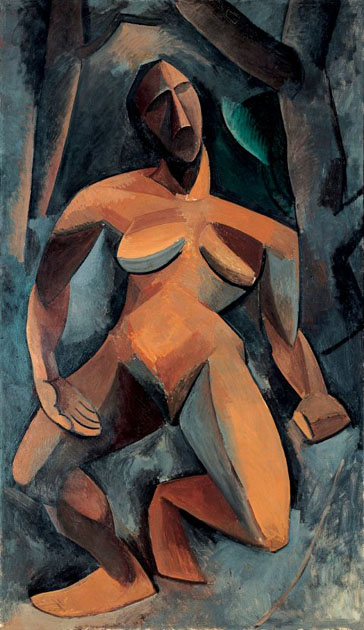
Five naked revellers, bursting from all times and none, hurl themselves about the canvas in the 20th century's homage to primeval energy. Opposite hangs Bonnard's vision of the dance, but here the participants cavort decorously in a bucolic Grasse landscape. The two works, painted at the same time, are at different ends of every spectrum, yet are embraced by the same creative enterprise. Their distraught conversation is flanked by Picasso's Dryad, Gauguin's Sweet Reveries and Braque's gloriously shaded landscape of the Castle at La Roche-Guyon. The exhibition is worth a visit for this room alone.

Sated with such riches we next hear the sound of Russian music (except there is sadly no music) in the form of a room devoted to Diaghilev. His Ballets Russes and Stravinsky's Rite of Spring were one Russian response to the impact of postimpressionist France. Bakst depicts the suave impresario with his old nanny, sad but emphatically present in the background.

Russian art now takes over, as painters stumble to meet the French challenge. They begin with their roots in iconography, symbolism and the patriotic realism championed by Tolstoy, Mussorgsky and Borodin. As France makes its impact, the consequences can be grotesque. Petrov-Vodkin's two boys dancing naked against a green and blue background is a horrible spoof of Matisse.

Painters of whom few will have heard seem derivative, mimicking expressionism, cubism, fauvism, even surrealism. Yet gradually they emerge into the light with a voice of their own. The names and works become familiar once more. We see Chagall's despairing Red Jew and his surreal love picture, Promenade. We see Kandinsky's Winter and Malevich's bold abstracts. At last the message seems to have taken hold. There is hope.

Suddenly it stops. Two brief decades of cultural penetration come to an end and darkness gathers. After the revolution most of these pictures disappeared from view, and by 1948 Stalin pulled down the shutters on the Pushkin Museum, to which Shchukin and Morozov had bequeathed their collections. It was, he said, "a breeding ground of formalist views and obsequiousness before decadent bourgeois culture".

My one regret is the absence from the show of the art of which Stalin approved, by way of contrast and warning. It ends on a dying fall in the emotional emptiness of dictatorship. There is only Tatlin's 1919 model of a gigantic spiral tower that, it was hoped, would be revolutionary Russia's answer to the Eiffel Tower. It was never built.

The works on display come from four museums, the Hermitage and the Russian in St Petersburg, and Moscow's Pushkin and Tretyakov. They offer merely a taste of the treasures buried in their vaults, which few people alive will ever see. About 90% of the Hermitage's collection is not on view, including works that any other museum, city or nation would give a fortune to exhibit. Yet, at the same time, these museums are chronically short of funds for showing or conserving what they have, let alone for acquiring or commissioning new work. They are the most extreme case of asset rich and cash poor.

Sooner or later the professional museum fatwa that treats these places as private curatorial archives and denies their governors freedom to trade collections must crumble. The crude chauvinism that says that a work of art must be "saved for the nation", even if then buried by the nation, is the most arrogant of imperial leftovers. Art should be displayed. Russia has more works of global appeal than it can possibly handle, yet desperately needs money to look after a fraction of what it has.

When Russia was rich, it garnered the choicest works of France and Italy, as Britain did before it and America afterwards. Today new lands and new publics should be able to purchase and enjoy at least what Russia (and others) cannot possibly display. International conventions can be drawn up to prevent abuse, like those of Britain's Museums Association and others debated in last September's issue of the art magazine Apollo. For example, pictures should be sold only to replenish collections, not to repair roofs, though even that is surely worth doing in extremis.

The world does not come to an end if a Monet or a Matisse hangs on a wall in Los Angeles or Dubai rather than being stored in a basement in Moscow or London. The world is enhanced thereby. Russia will always have treasures and to spare to stage a display like this. What it cannot display it should sell to those who can. Pictures are painted to glorify the light of day, not the gloom of vaults.


simon.jenkins@guardian.co.uk


If you are interested in the painting exhibits, you can check them out here.

Thursday, February 21, 2008

Rs.200 can change the life of this guy...

Last week, I met a boy named Soundrapandian in a village called Elanthugudi, near Mayiladuthurai. My friend’s dad who is a school headmaster bought Soundrapandian to my notice.
Soundrapandian finished his MCA with First Class in 2005. So, what is so special about him? He might have passed the exams, but still has got many difficulties which need to be addressed. This guy is crippled with Polio to an extent where he cannot walk even with crutches. Worse still is his parents who were taking care of him are no more. He was under the care of his elder brother who also passed a few years ago. He has got a younger brother who also is crippled with Polio. Though his younger brother can walk, he cannot climb stairs, not even board a bus. Being the eldest son in the family, Soundrapandian needs to look after his younger brother, his brother’s wife and children.
So, what to do? He had enrolled himself in Tamil Nadu Government’s employment exchange which gave recommendations to some IT companies for enrollment. But multinational companies rejected citing they don’t need work force at the moment (Good joke indeed).
During his college years Soundrapandian worked part time in a computer center called Tamil Nadu Software College in Mayiladuthurai. After completing his MCA, he had worked full time also. But now, there is no one to take him to the institute, which is ready to offer a job at a decent salary.
So, what can we do?
A tricycle for the disabled costs Rs.3, 800 (Three thousand eight hundred rupees), if 19 of us can shell out Rs.200 each, we can get him a tricycle. You see this amount which is not very large can change the life of the family. If you are willing to contribute Rs.200, kindly please mail me at sathishmayil@gmail.com or call me at 94425 51364
Click here to view his certificates
Do remember the Chinese proverb “Give a man a fish and you feed him for a day. Teach a man to fish and you feed him for a lifetime.”
Though i am in a NGO I cannot help via it, since it serves only education.
Please don’t forward this mail and make it a mail chain.

Saturday, February 16, 2008

The Books Interview: Ramachandra Guha

The publication of Ramachandra Guha’s thrilling history of India from 1947 to the present day India After Gandhi was one of the highlights of Indian literature in 2007. Guha, whose other books include a biography of the anthropologist Verrier Elwin, the awardwinning social history of Indian cricket A Corner of a Foreign Field, the marvellous anecdotal history The States of Indian Cricket, a history of the Indian environmental movement (with Madhav Gadgil) and the book of essays An Anthropologist among the Marxists, kindly agreed to answer a host of questions about India After Gandhi and also about the nature of the historian's craft, favourite books and bookshops, Indian newspapers, and food.

Six decades after independence, democracy is now quite deeply rooted in our psyche and in our language: we are at home with democracy, or at least with the rhetoric of democracy. But as you demonstrate, the decision in 1947 to move straight to a system of adult universal suffrage was "the biggest gamble in history". Could you reprise just why this move was so radical?
In the West, the franchise had been granted in stages; first only men of property were allowed to vote; then men of education were added on to the list. The male working class had to struggle long and hard to be deemed worthy of the privilege. Women had to struggle even longer; in a supposedly “advanced” country like Switzerland, women were not permitted to vote until 1971! This is what makes the Indian experiment so radical. So soon after Independence, a poor and largely illiterate citizenry was allowed to freely choose its own leaders. All Indians above the age of 21, regardless of gender or class or education, were granted the franchise. There was, as I show in India after Gandhi, widespread scepticism about this experiment; many Indians, and most foreigners, thought it would never work. But it did.

Although India After Gandhi is 900 pages long, its scope is so vast that you must have left out at least as much as you left in. Did you find that work on this book was an especially demanding instance of that problem which all narrative historians must grapple with: the selection of detail?
I did leave out quite a lot, though certainly not as much as I left in! I cut 40,000 words from my final draft, these mostly original quotes from primary sources. Even so, the book runs, as you say, to 900 pages. My publishers, my agent, my closest friends, had all warned me that a history book about India would not sell if it were more than 500 pages long. In the end, my American and British editors, together, recommended very few cuts–perhaps 5,000 words to add to the 40,000 I had myself deleted. No reader has (yet) complained about the length; although many readers (beginning with my wife) have complained that the book is too bulky to read in bed.
As I explain in the prologue, historians of India have taken 1947 as a lakshman rekha they cannot cross. My real hope for this book is that it will encourage younger historians to write books of their own on the history of independent India, which is without question the most interesting country in the world. Each of my chapters should be a book. Several of my sections could be developed into books. There are themes I have treated only fleetingly (for example, the history of Indian architecture since 1947) that could be made the subject of whole books. And many of the characters who figure in the pages of India after Gandhi­—for instance, Sheikh Abdullah, AZ Phizo, JB Kripalani, and NT Rama Rao—deserve full-length biographies.

The decades immediately before and after Indian independence also seem to have been a golden age of political leadership. Your chapters on this period are among other things a chronicle of the contributions of our own Founding Fathers - Gandhi, Nehru, Patel, Ambedkar and a host of others. None of these men except Nehru had a family background in politics, yet they were all drawn to politics, and as you show they were all in some way above politics. Is this just a historical curiosity? Must a democratic citizenry be reconciled to not expecting greatness in its statesmen?
A I think that it was, alas, a historical curiosity, or more accurately, coincidence. Rarely in any country’s history have so many men and women of intelligence and integrity taken—at more or less the same time—to the political life. We Indians are insufficiently aware of (and certainly insufficiently grateful to) the country’s Founding Fathers and Mothers. We owe them much more than we realize. Now, intelligence and integrity have mostly left the sphere of politics—although they are visibly present in the realms of social work and social activism, entrepreneurship, and in professions such as medicine and the law.

Your book synthesizes an impressive amount of scholarship. Among the concepts you take up, I was struck by W.H. Morris-Jones's idea of the three idioms of Indian politics: the modern, the traditional, and the saintly. Would you like to elaborate on this idea, and perhaps explain it in terms of a contemporary Indian debate?
I suppose Dr Manmohan Singh represents the modern idiom, and someone like Medha Patkar the saintly idiom. However, most important or successful leaders nowadays practice one or other version of identity politics—and thus would qualify as ‘traditional’ in the terms of Morris-Jones. Caste, region, religion—these continue to shape and define how politicians win elections and how they run their administrations.

Would you like to talk a bit about the works of history that have most influenced your understanding of the art and craft of narrative history? I know that the historian Marc Bloch was an early influence on you...
Apart from Bloch, his great Annales School colleague Lucien Febvre was also an early influence, as was the British social historian EP Thompson. I have also learnt a great deal from Indian writers, particularly the sociologists André Béteille and MN Srinivas—the two scholars who, in my view, have written most insightfully on society and politics in modern India.
A historian must read capaciously, and eclectically. He must read writers Indian and foreign, theorists as well as biographers, sociologists and essayists apart from formally trained historians. But in the end he must use the narrative style that works best with the theme that he has chosen and the material that he has gathered. In this sense, no other historian or book can serve as a model or exemplar. If you compare India after Gandhi with some of my other books, you will see that it is more sociological and argumentative than Savaging the Civilized, my biography of Verrier Elwin (which had to follow a person’s life and emotions closely); yet less sociological than A Corner of a Foreign Field, my social history of cricket, whose organizing categories are race, caste, religion, and nation.

Your research for India After Gandhi must have thrown in your path many texts about Indian history, politics and culture that are now little read. Would you like to talk about some that can still be read for pleasure and profit?
I don’t know about ‘pleasure’, since very few Indian historians write with any sense of style. An exception must however be made for Sarvepalli Gopal, whose lives of Nehru and Radhakrishnan can indeed ‘still be read for pleasure and profit’. Among the other books that I found particularly valuable in terms of the depth of their research, or the spotlight they threw on important issues, were Prafulla Chakravarti’s Marginal Men (a study of Bengali refugees in Calcutta), and Sisir K. Gupta’s meticulous study of the first decade of the Kashmir dispute.

Must a historian read the newspapers closely? What newspapers do you read? And would you like to provide an account of your changing relationship to the newspaper over the course of your life?
A historian must certainly read, and closely, the newspapers of the period or region he is writing about. For both India after Gandhi and A Corner of a Foreign Field I spend many enjoyable hours looking at microfilms of old newspapers and magazines. The riches of India’s periodical press are an under-utilized resource, since many historians still tend to restrict themselves to official records.
The newspapers of the present day are another matter. Growing up, my favourite newspaper was The Statesman, which combined elegant English with a sturdily independent editorial stance. It was destroyed by a megalomaniac named CR Irani. Back in the 1970s, the Times of India was also a real newspaper; now, as we well know, it is a fashion supplement. If the TOI is too frivolous, then The Hindu is perhaps too solemn. Now, in 2008, my favourite Indian newspaper is The Telegraph of Kolkata, and I often also find things of interest in the Hindustan Times. On the whole, though, I feel that the quality of the English-language press in India has declined over the years. There is too little grassroots reporting; too much celebrity journalism. Editors and columnists are too closely allied to particular politicians or political parties.

In 2007 there was a boom in the publication of books on India both at home and in the west. Are there any books amongst these, whether for a scholarly or a lay audience, that have caught your eye?
The two books on India that I most enjoyed in 2007 were both on that most elevated of art forms, Indian classical music. I was very struck by a remark once made by Amitav Ghosh, to the effect that our classical musicians are the only Indians who strive for excellence and achieve it. Their art is richer and more subtle, and calls for far great discipline, than the game of cricket; and it brings the artist in touch with the Divine.
I mention cricket because it is a game we both love to distraction, and both of us write about. But give me M. S. Subbulakshmi over Sachin Tendulkar any day. Sadly, our shastriya sangeet has not really been written about (at least in English) with insight and imagination; there are no musical equivalents of Sujit Mukherjee or Mukul Kesavan. Or not until last year, when Kumar Mukherji published (posthumously) The Lost World of Hindustani Music, a wideranging anecdotal history of many musicians and many gharanas; and Namita Devidayal published The Music Room, her evocative memoir of singers from a single gharana.

Which is your favourite bookshop in the world?
I have many favourite bookshops: John Sandoe in London, the Strand in New York, Clarke’s in Cape Town, and the New and Secondhand Bookshop in Mumbai. But the one I love most is Premier Bookshop, off Church Street in Bangalore. Its owner, T. S. Shanbagh, is a man of much charm combined with a sly humour. His books are arranged in a most eccentric fashion, but he knows where each one is, and knows too which new arrival is likely to interest an old customer. I have written a tribute to Premier in an anthology of writings on Bangalore edited by Aditi De, which Penguin will publish later this year.

Let us say you were hosting a dinner party and had the liberty of inviting half a dozen personages from the entire sweep of Indian history. Who do you think you would want at your table and why? And what then might you talk about?
That is a tough one! To make matters easier, let me restrict myself to the recent past. I guess I must have the four modern Indians I admire above all others—Tagore, Gandhi, Ambedkar, and Nehru. Then the great (or at least brilliant) Indian whose politics and personality is somewhat at odds with this quartet—namely, Mohammed Ali Jinnah. That will surely get the sparks flying. Finaly, the socialist-turned-social worker Kamaladevi Chattopadhyay, not to fill in the gender quota, but because of the range of her experience and the independence of her mind, not to speak of her penchant for puncturing pomposity wherever it was to be found.
The conversation? Perhaps I might begin by asking Gandhi his opinion of his fellow Gujarati, Narendra Modi. Ambedkar might then offer his views on Mayawati, Nehru his views on Rahul Gandhi, Tagore his views on Amartya Sen (whom he named). I think we can trust them to take it from there!

These interviews always end with a question about food. As you have travelled widely around the country, and lived for considerable periods of time in the south, the north, and the east, you must have left your footprints on thousands of eating-houses. What is your favourite memory of a meal?
The older I get, the more I relish Indian vegetarian food. Gujarati cuisine is a favourite, of course, but so is Bengali vegetarian food (I grew up in Dehradun in close proximity to a home in which lived a Bengali widow, for whose delectation—since she had little else to look forward to—this cuisine was first fashioned). But my most memorable meal was had in the Admaru Mutt, adjoining the famous Krishna temple in Udupi. I had been at a conference in the neighbouring town of Manipal, whose presiding deity was the Kannada writer UR Anantha Murty. On the last day of the conference we were taken to the Mutt for lunch by Anantha Murty. The Madhava Brahmins love their food, and this particular meal consisted of forty-two separate items, each listed on a printed card. Udupi is on the crest of the Western Ghats, so to add to the various varieties of cultivated cereals, legumes, and vegetables came a whole array of items picked from the forest—among them wild mango, jackfruit curry, and bamboo shoot pickle.
The meal was made more memorable by the company. We ate sitting cross-legged on the floor. On my left was the Sikh sociologist J PS Uberoi, on my right the Christian anarchist Claude Alvares—both accustomed by culture and upbringing to deprecate vegetarian food as simply ‘ghaas’. Opposite me was the veteran Gandhian Dharampal—not allowed by his upbringing to eat meat, but not allowed either to be exposed to such subtle varieties of taste and essence. As we ate, Anantha Murty walked up and down, explaining the origins and significance of each of those forty-two dishes.
When I was young, I used to say, at the conclusion of every concert by Mallikarjun Mansur that I was privileged to attend: ‘Please, God, allow me to hear this man once more in the flesh before he dies’. Now, from time to time I ask the fellow above that I may be allowed one more meal at the Admaru Mutt before I die.

(Courtesy Mr.Chandrahas Choudhury, and I encourage reading his blog)

Wednesday, January 30, 2008

Paycut!!!

This is just the beginning. Expect the same from every software company in India,

Click here

Tuesday, January 22, 2008

"Real" Dream - 2


Everybody has a dream. Only a few go on to reach their dream, but they have to undergo various difficulties to attain them. Don't think your dreams are over. Its not, if you can put in that extra effort you can achieve your dreams.

I wanted to be an electronics engineer. I was amazed at the Electronics chapter which we had to study during our Twelfth standard. I was deluged in all the fascination about how I am going to study in electronic scale about working of a radio, TV, etc... As a matter of fact, I didn't study those stuff nor I am working in my field of interest.

I would say four factors that would affect you destiny,

1. Good Education / Institution:

We have a post in our blog stating the education system in India. The educational system should be upgraded as it is outdated. I found that people where teaching vaccum tubes when there is already a revolution in Transistors and MoSFETs. It also depends on the socio-economic class of the student. If he can afford money then he can get admission in good institution.

The education system has become more of a business nowadays. People who have the money power (and muscle power) have started to build institutions and are gaining profit from them. I dont want them to provide education for free (after all they need money to survive), but they could atleast stop the huge amount of donation they claim from those poor parents. I have seen colleges collecting hefty fines and defaulters were made to stand outside the directors office (Like a Watchman!!!) or sometimes suspended. They dont care about the welfare of students anymore . All they care about is money. I am not blaming all of them. We can find some people who have that conscience (or pity) to help the students in their studies and not hinder them.

In the early 20th century, people donated their wealth in order to build educational institutions and help the people in need. In modern days, its the other way round, you take the money from the people to build more educational institutions in order to acquire wealth.


The sad part is even the government are not interfering in these matters. They dont want any trouble from those hotshots (as some of the educational institutions are run by people who are prominent in either the ruling party or the opposition party). They dont care a damn about education to poor, all they care is free TV for the poor when there in energy shortage.


2. Parents:

The role of parents is very important in making you dream come true (or rather their dream come true). Now honestly how many parents would love their child to be an artist, lyricist,etc.. They (some of them) want to impress (or exceed other children) their relatives and friends, so they try to push in their ambitions into our mind. They dont allow you to settle in your minds. They constantly come up and say to you what they want us to become, they dont listen what we want to become. If the kid wants to become something other than what their parents want to be, they are brain washed.


Parents should be supportive of their kids, they have understand what the child wants and not what they want from the child. These days , the interaction time between the parents and the kids are dwindling at an alarming rate. In most of the middle class families, both the parents are working and they come home only by 7.30 pm and the kid is under the supervision of a servant or he will be in some tution class. The kid arrives at 8.00 pm or he is already tired of these classes , so he takes his dinner and goes to sleep. People should listen to what the kid has done in the school, they should follow their activity, spend time with them and thats how the bond between the parents and kid will become stronger. Richard Feynman admired his father, you can find references of his father teaching him in some of his books. Maybe thats why he decided to become a world renown scientist. The interaction between a child and his parent may shape his ambition/career.


Again, if you see from the parents' point of view, they are quite helpless, they want their kids to be in repectable job rather than risking his career for some other profession. Most of them struggle to raise their kids and they expect some payback from child. They think if somehow he/she becomes engineer or doctor, he/she can continue to serve the family. So they are apprehensive of sending their son/daughter to their area of interest which may put the entire family at risk. They are really constricted to some ideas (their ideal world), they dont want to think outside that world.

3. Teacher:

The teacher plays an important role in making one career. Most of the teachers are sub standard,Why? The reason is something to do with the topic of the post. Most of them dont pursue their dream, but forced to come into teaching profession becuase of their family circumstances or due to lack of jobs of their interest. There have been some really good teachers, who have dedicated their lives to teaching, but we need some real gems to force the talet out of the child when a parent fails to do so.

4. The Students:

I would say that the students also play an important role in ruining their ambition/career. Let's for example take engineering, we have been provided facilities (atleast some) when some children could only dream about. Most of the people are forced into engioneering, but there are some people whose ambition is to study engineering. Does all the guys/girls who do engineering study properly? No, I dont think so. We can go about complaining that the facilities weren't there, the teachers weren't good, did we improvise? No. All we did was having fun all the time (maybe sometimes we studied), enjoying life and lost our opportunity to learn more when we had the facility (little facility). We were enjoying with our friends when we should have deluged ourselves in the library books, but we rarely did that, when we did that it was mostly to skip classes and to pass time without much ado.

People dont want to explore the subject, they want to be spoon fed by the teachers. All they want is to score good grades (which is actually important) without actually knowing anything. People have to explore beyond what they have been taught. Its time the students change their attitude, they have internet. Even if they are not taught well, they can go browse the net and actually learn the stuff rather than complaining.

It also takes immense courage to pursue your ambition. It may include going against tradition, parents wishes etc. There are some people who have done it. I knew personally some of the people. I salute them for their courage and reflect upon my cowardice and try to find a workaround for it.

I agree there are exceptions in all the four points I have mentioned above. Finally, I leave you with these two examples to ponder about. One from the past and one from the present.

i) Leonardo Da Vinci - Illegitimate son of a wealthy man. He didnt have education like us or the facility that we have now. Look at him, he did everything - he was a painter, sculptor, engineer, mechanic, designer, scientist,etc... He did everything he wanted to do and succeeded in it.

ii) http://xlalumni.blogspot.com/2007/11/xlri-homecoming-07-idli-boy-steals-show.html

No excuses for any of us. If he can do it, we can do it. We still have time to pursue our dreams. Who's Game?

Running after your "real" dream.

Hi all,

Imagine what Da Vinci, Zidane, James Hetfield, Godel or whomever great you can imagine would have wanted to become. By becoming something does not mean only our profession but our ambition. I tend to stutter here because I could not make out the difference between career and ambition. This might be the case for many as we are born in India - I suppose.

People, try flying by your past and recollect what you fantasized to be and what you are now. Now that we are mature and we tend to acclimatize our dream or maybe try forget our dream as we can safely say "I made a smart and realistic decision".

What might stop one from becoming a great poet or a painter or a musician. Let me list out some.
1. Fear of inquisition that we might recieve from society.
2. Fear of survival.
And many other list of fears that haunt us. Or I might say that drive us to run in an opposite direction.

Take some time off for introspection. Lets do some reverse engineering. I'll take my own case. I'm an CSE Engineer. What drove me to become one? Fantasy surrounding computers, was interested in maths, heard from someone that CSE has lots of maths and logic- which gave my conscience all clear to choose CSE.

This point is where i strongly feel something is missing. Did I do the research about computer engineering, if it is good or not? No. Is that because I was not exposed to computers much. Is our educational foundation not balanced? Or that I just did not care what I want to be?

I think even now, in this age many just dont know what they want to do in future.. Or what they want to be in future.. People just wait for the jigsaw puzzle to get over all by itself.... they dont go in search of the pieces that help them to solve the puzzle. Once you have the location of the pieces then you can think about the plan of action on how you can solve it.

Do you have the pieces that solve the puzzle or you in search of the pieces or just that you dont know you are in the middle of a puzzle?

I want this to be an open dicussion. Please comment.

Thanks,
Gnanesh.(Poonai)

Sunday, January 13, 2008

Beyond old Kollywood

This is another posting about movies.I couldnt resist posting this from The Hindu,

“Kalloori” is the finest Tamil film of the year. After “Kadhal”, Balaji Sakthivel could have easily made an ambitious film with big stars, but he chose instead to do something smaller, on a more intimate scale. You have to admire him for it. There are few false notes in “Kalloori”, a film about three years in the life of nine college friends. Character, plot and dialogue are flawlessly rendered, staying faithful to its small town roots, never once betraying its authentic rural sensibility. The actors look uncompromisingly South Indian: every face here reminds us of real people and there’s no attempt to airbrush the actors and make them movie-handsome. Sakthivel maintains a fine, calibrated balance between the formulaic and the artistic.

“Kalloori” is only one example among several recent Tamil films that point to a very quiet but exciting revolution taking place in contemporary Tamil cinema: an unexpected, astonishing move towards realistic, intelligent, strongly scripted storytelling. Ram’s “Kattradhu Tamil” and Ameer’s “Paruthiveeran” are also remarkable instances of a new kind of movie in Tamil. What is just as remarkable is their modest success at the box office. In some ways, a film like “Kalloori”, deftly weaving Kollywood and realism, is more ambitious and more entertaining than a big budget film with stars. Is this the new Kollywood?

New wave

What these new wave of Tamil films seem to be doing is to fuse the energy and entertainment of a mainstream film (without its formulaic excesses) with the complexity and sensitivity of an art film (minus the excessive artiness). Mani Ratnam invented it in “Nayagan” and perfected it in “Aayitha Ezhuthu”, but it took all these decades for a newer generation of filmmakers to follow his genius. Other recent examples in this new wave are: Thankar Bachchan’s “Pallikoodam” and “Onbadhu Roobai Nottu”, Vetrimaran’s “Polladhavan”, Nishikant Kamat’s “Evano Oruvan”, Padma Magan’s “Ammuvaagiya Naan”, Gnana Rajasekharan’s “Periyar”, Vasanta Balan’s “Veyil”, Selvaraghavan’s “Pudupettai” and Cheran’s “Thavamai Thavamirunthu”.

Suddenly, it seems there is a new Tamil audience, a young audience, willing to see new things. The big Deepavali releases, “Azhagiya Tamil Magan”, “Vel” and “Machakarran” for instance, seem un-entertaining and even tame to a new Tamil audience now used to a cinema that is more inventive.

The Tamil New Wave is also characterised by style, personal filmmaking, a minimum song soundtrack (with songs in the background rather than lip synched and danced to) a shorter running time, no parallel comedy track (the comedy arises instead from within the plot) and themes that are sharply observed, tough-minded explorations of rural life and life on the mean streets. The characters here are rooted in family, culture and tradition but are forced to break with everything because of their personal choices — usually love or ambition.

The significance of these films is not for Tamil cinema alone. Their influence is already being felt through the rest of Indian cinema, signalling to filmmakers that our formulaic movies can be reinvented.

Already paralleling the Tamil revolution is a new kind of Hindi movie, evidenced by “Hazaaron Khwashien Aisi”, “Black Friday”, “Omkara”, “Iqbal”, “Page 3”, “Mixed Doubles”, “Rang de Basanti”, “Dus Kahaniya”, “Khoya Khoya Chand” etc. Except their themes are urban, looking at sex, adultery, relationships, work pressure, crime and everything else that contemporary living throws up. If Tamil movies depend too much on a rustic milieu, Hindi movies lean too much on the urban. Both cinemas need to crossover.

How exactly did this new cinema come about? Had its young audience, now exposed to better cinema from around the world, begun to tire of the more formulaic, fantasy-driven films? Or was it the young directors themselves who now desired to tell new stories in new ways?
The frontrunners
It is difficult to pinpoint the exact moment when this film revolution in contemporary Tamil cinema started, but I’d like to mark two films as possibly having inspired and kick started this new wave:” Autograph” and “Kaadhal”. Both films were artistically made, entertaining, and — most crucially — huge box office hits. It must have startled the Kodambakkam industry to see two intimate love stories with no stars winning such a huge audience.

Balaji Sakthivel’s “Kaadhal” and Cheran’s “Autograph” signalled two things to Kollywood’s aspiring younger directors — that there was an audience for character-driven, strongly scripted, low budget movies, and that there were bold producers and passionate filmmakers willing to risk telling more realistic, intelligent, personal stories.

Sakthivel brings a documentary naturalness to the acting in “Kalloori”, especially with Hemlatha as Kayal, who can actually make you forget she’s acting. He coaxes an achingly beautiful performance from Tamanna; a complex, intense performance I have not been able get out of my head, one that heralds a major star. “Kalloori” is admirably restrained, subtly humorous and scene-by-scene enjoyable.

Ameer’s “Paruthiveeran” stunned an audience with a brutally detailed depiction of clan wars in rural Tamil Nadu. The first Tamil film to evoke small town life precisely: the festivals, rituals, locale, characters, and dialect. Its strongest character, fascinatingly, is a woman, Muthazhagu (an audacious performance by Priyamani), the heroine who fiercely knows her mind and heart. The scene where she eats with a ravishing appetite just after being sickeningly beaten by her father reverses everything we’ve seen in our movies about women and patriarchy.

Unpredictable

If “Kalloori” is the best Tamil movie of the year, “Kattradhu Tamil” is the most underrated. Ram’s film is original, unpredictable, disturbing and provocative. Prabhakar (Jeeva scorching as a bearded Dostoyevskian hero) has an M.A. in Tamil but it gets him nowhere. He runs into classmates half as bright as him doing fabulously well working for BPOs, while those with a degree in the arts and humanities are marginalised into obscurity. Working as a young Tamil teacher in Chennai for a poor school, Prabhkar narrates his terrifying journey (to Karunas, usually a comic sidekick, who does a superb about turn as a character actor) from idealism and rage to madness and oblivion.

What this postgraduate in Tamil has to say about how irrelevant those who have given themselves to Tamil culture and literature have become in an increasingly Anglicised society feels alarmingly true and painfully ironic. “Kattradhu Tamil” is uneven, dark, and violent but also full of conviction with an uncompromising vision.

The only aspect that slightly mars many of these offbeat Tamil films is their tendency for dark, morbid, violent endings. They seem to interpret any realistic portrayal as necessarily ending in tragedy, almost to say: realism equals tragedy. “Paruthiveeran”, “Kattradhu Tamil” and “Kalloori” also make this error. What they don’t realise is that after soaking in the despair and struggles of these characters, what we in the audience want to see is the triumph of these characters (however small that might be) over their fate. We want to see is Veeran and Muthazhagu, Muthuchelvan and Shobana, Prabhakar and Anandi take flight, escape the past and find a new life. Surely they’ve earned it.

Through the last decade and a half there have been other one-off films that were also intelligent and artful, but because they popped up sporadically and were not, unlike the new Tamil movie phenomenon, part of a gathering movement, they never achieved sufficient momentum to make a strong impact and change the idiom of contemporary Tamil cinema. But they nudged the revolution closer: Films such as Durai’s “Mugavari”, Susi Ganesan’s” Five Star” (his “Thiruttu Payale” is also noteworthy for the way its dark hero stays faithfully in character right up to the end) Suhasini Maniratnam’s “Indira”, and Ameer’s “Raam”. And then, more recently, there have been these other little, deft entertainers — romantic dramas and comedies where the emphasis is not on being realistic or authentic but in being charming and believable: Priya’s “Kanda Naal Mudhal”, Azhagham Permual’s “Dum, Dum, Dum”, Radha Mohan’s “Azhagiya Theeyae” and “Mozhi”, Vasanth’s “Yei Nee Romba Azhaga Irrukkai” and “Poovellam Kettupaar”, and Cheran’s “Mayakannadi”.

Smart and stylish

Even the new wave of Tamil gangster films — “Pudupettai”, Mishkin’s “Chithiram Pesuthadi”, Linguswamy’s “Sandakozi”, Vishnuvardhan’s “Pattiyal” and Vetrimaran’s “Polladhavan” — and thrillers — Gautham Menon’s “Kaaka Kaaka” and “Pachaikilli Muthucharam”, Igor’s underrated “Kalaba Kadhalan”, Vasanth’s “Satham Podaathey” — have a new grittiness and edge to them, and are smartly written and stylishly crafted.

There is plenty that is still disturbing about even new Tamil cinema: endless violence, obnoxious attitude to women, and ingratiating tropes. What is cause for celebration, though, is that this vibrant new cinema in Tamil is not at its culmination but is just beginning. Already in “Kalloori” there is no violence, no caste politics, and no item numbers. It certainly feels like Tamil cinema has finally grownup, turned a corner, and gone beyond old Kollywood.